Estrella Mountain Community College (EMCC) students are all abuzz since receiving some sweet news. The National Science Foundation (NSF)-funded native bee research project that they are part of has just been extended. “The BUZZ: Engaging Community College Students in Native Bee Biodiversity Research,” originally set to run from 2023 to 2028, will now continue through 2033.
“We were ecstatic to find out that the project was recently awarded a second five-year cycle,” EMCC Biology Professor and faculty mentor Dr. Jarod Raithel said. “I have been mentoring undergrad researchers at EMCC since 2017, but I have never been a part of an undergraduate research experience project of this caliber, with this level of dedication by these students over the past few years.”
The BUZZ undergraduate research experience, or URE, aims to collect as much data as possible on the numbers and types of native bees in Arizona and California to inform future conservation efforts. The ultimate goal is to stabilize native bee diversity by developing an extensive network of habitat pockets, resulting in resilient metapopulations.
EMCC is one of 28 colleges in the two states participating in the research project. Each college develops its own research questions and individual analyses, based on shared methodology. EMCC’s project involves compiling a list of host plants conducive to native bee foraging to advise future landscaping efforts and mitigate the potential damaging effects of urbanization on bee biodiversity.
“One out of every three bites of your food you owe to bees, and we don’t even have a baseline to know how many bees we have,” Dr. Raithel said at the project’s onset. “They are crucial to our survival, yet we know so little about them.”
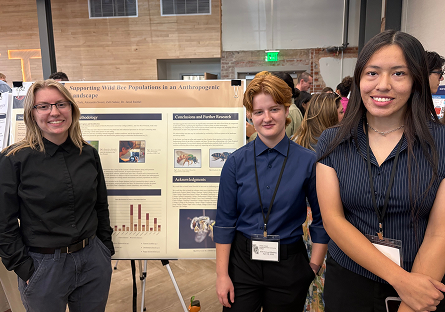
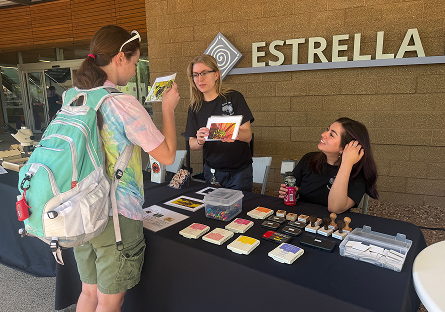
Since the project began, EMCC students have identified, or keyed, around 600 native bees comprising 31 genera from around campus and the Base and Meridian Wildlife Area (Tres Rios) in Avondale. They have presented their findings at numerous conferences and symposiums in Arizona and California, guest lectured in multiple Biology classes here at EMCC, and displayed at several showcases, open houses, and festivals across the Valley.
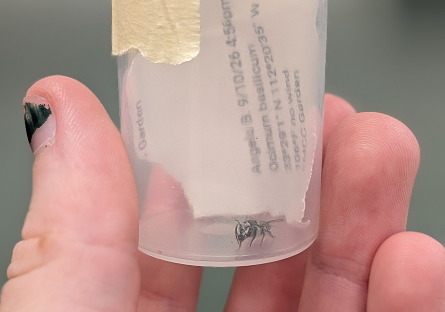
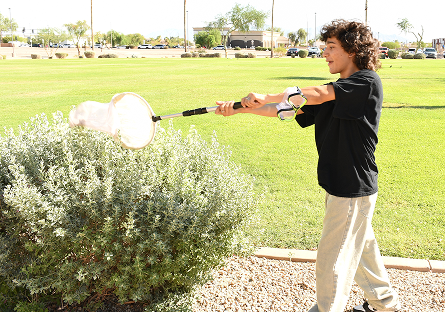
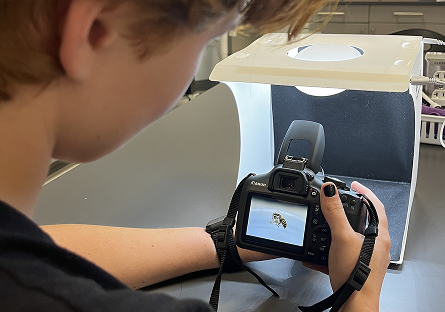
Identifying bees is no small feat. Students must first capture a bee, then note the time, date, location, weather conditions, and plant the bee was on before taking it back to the lab to photograph it from several different angles, study it under a microscope, compare it to a dichotomous key, and finally upload their findings to a shared database. But Arella Clark and Alex Sweet, two of the original researchers who started on the URE project in 2024 — have made it easier for future students. In addition to creating a Native Bee Conservation website, they have also created a YouTube Native Bee Team page filled with training videos.
“It was our main priority and goal this summer to create a nice visual aid to teach others,” Alex said. “Since being on the project for four semesters, we had developed a lot of specific steps to follow. Maintaining the same methodology and collection processes ensures that our data and analysis are consistent.”
Dr. Raithel said the videos are amazingly thorough and professionally done, and will aid future research students in ensuring the project’s success. The taxonomist on the BUZZ project even asked to share the videos with the other 27 colleges.
“Continuity from team to team in how we collect data is so important to minimize confounding factors,” Dr. Raithel said. “If we want to look at trends over time, in who we are catching, and when, as the climate rapidly changes before our eyes, we have to be consistent in our survey effort and methodology. It’s fundamental.”
Alex and Arella both graduated last spring and have moved on to Arizona State University West, but they haven’t completely left the project behind. They came back to EMCC for the group’s first meeting of the fall semester to pass the reigns off to the group’s new lead, Zalli Salaiz; introduce their training videos; answer questions; guide new students on next steps; and share the work they completed over the summer — keying about 350 bees on backlog.
“We wanted the new team to have a fresh start,” Arella said. “With all the time Alex and I have put into developing the project, we’re definitely a little protective over it and wanted to make the transition as smooth as possible.”
From what they’ve seen so far, their “baby” is in good hands.
“Zalli, the new lead on the project, has been involved for almost the same length of time as I have, and we definitely trust her to continue it in our stead,” Arella said. “The other amazing members are really hard-working, and we’re confident that they will keep the project going and continue to make amazing progress.”
One of those amazing members is Angelo Bustamante, an Arizona Agribusiness & Equine Center (AAEC) student concurrently enrolled at EMCC. He joined the research project at the end of the fall semester last year.
“We were very fortunate that Angelo joined the project,” Alex said. “Every time we saw him, he impressed us yet again. It was really amazing to see his true passion, work ethic, curiosity, attention to detail, and devotion. This project meant so much to Arella and me, and we both feel comfortable and confident with it continuing with Angelo and the rest of our incredible team.”
Angelo signed up for the research project because he was looking for a way to get more involved on campus, and this particular URE centered on something near and dear to his heart — wildlife. And while he admits that he was initially hesitant to sign up because he wanted “me time” after school and homework, he’s glad he did. Not only has he found that what he once thought was a gnat could be a native bee, but he has also found a second family.
My perception of bees has changed so much — everything could be a bee now — I’ve discovered that half the things I thought were beetles or flies were actually bees,” he said. “But I was really surprised at how easy it was to meld into the group. I don’t think I’ve ever had a time when I was uncomfortable or felt out of place — they are all so friendly, and great mentors, very patient — and after week two, it just felt like home.”
Angelo began taking classes at EMCC in 2023 during his freshman year of high school, a requirement to attend AAEC, which is within walking distance from EMCC. He thought taking college classes while still in high school was going to be very daunting, but once he found out that his college classes would count toward his high school credits, he quickly found his fears to be unfounded.
“Once I realized it was a trade-off, it became easier,” he said. “The workload didn’t increase; it just changed.”
Angelo will graduate from AAEC next spring and finish his Associate in Science with an Emphasis in Biology Degree here at EMCC before moving on to a (hopefully coastal) university to study Marine Biology. He is considering Oregon State or the University of Oregon because he loves the weather, the walkability, the trees, and the people.
“Ever since I was a kid, I’ve been obsessed with marine life and wildlife in general,” he said. “I grew up watching shows like ‘Wild Kratts,’ ‘Nat Geo’ documentaries, and ‘Shark Week,’ so it’s been a thing I’ve always wanted to do.”
Though Angelo has only been on the BUZZ project for a little over a semester, Dr. Raithel sees him taking on more of a leadership role this year, and Alex and Arella agree that he’s got what it takes.
“He is absolutely leadership material, and I really look forward to seeing him continue to develop in that role,” Arella said. “I know Alex and I are both sad to leave the project behind, but we feel much more confident in it moving forward with Zalli, Angelo, and the rest of our excellent team.”
Are you an EMCC student who is interested in joining the native bee research project? Email Dr. Jarod Raithel at jarod.raithel@estrellamountain.edu.